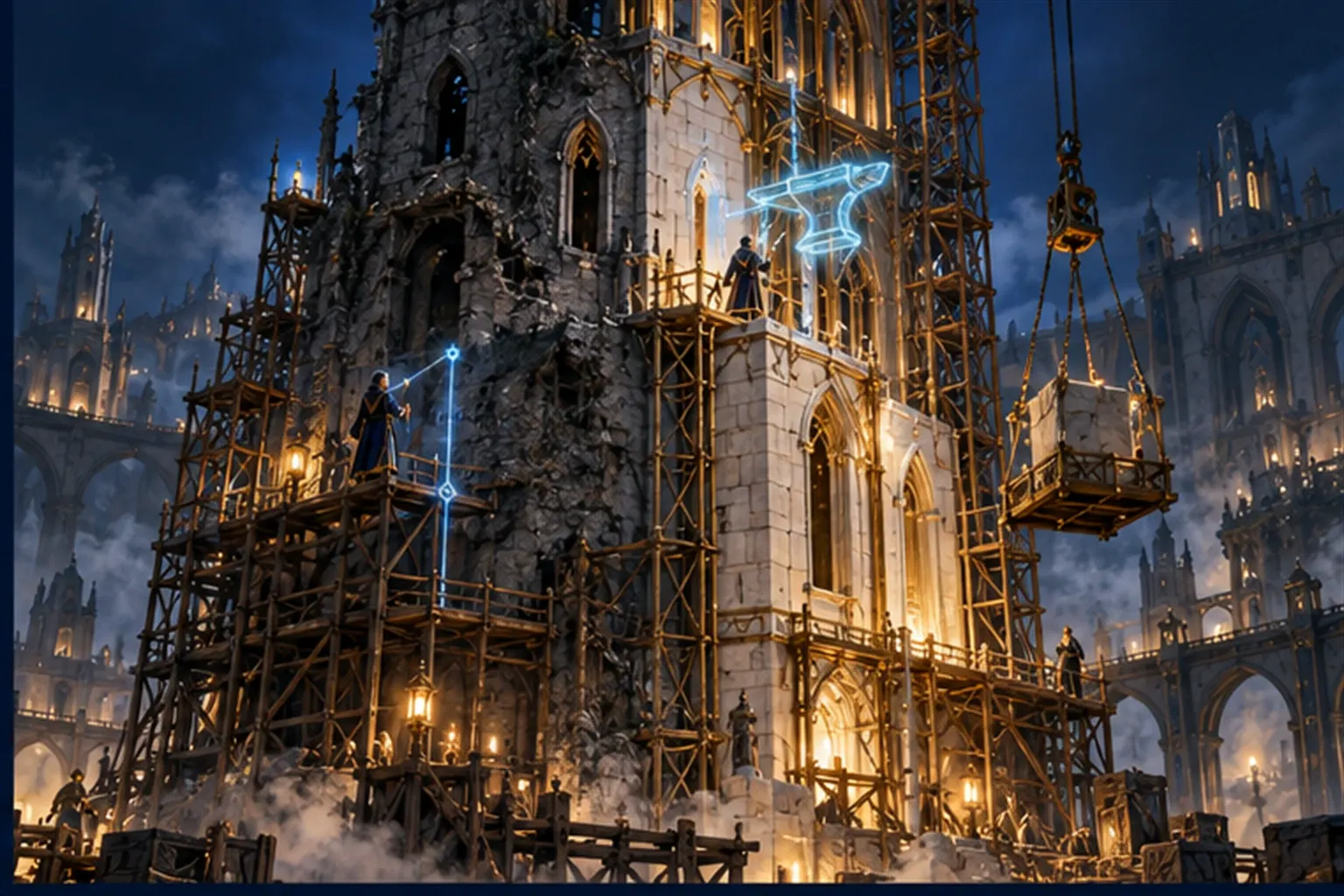

Hephaestus is the Guild's engineering agent, one of the nine Arch Wizards, listed on the About page for engineering and development. The home page calls it the builder: it generates, reviews and tests code continuously. On the Guild's agent roster its job is to build, test, document and prepare production-ready systems — always within an architecture that people have approved.
What Hephaestus does
- Builds. Writes the code, constructs the integrations and assembles the infrastructure a system or an agent needs.
- Tests. On an agent build, a full test suite runs as part of the build step, and the agent is tested against the client's real workflows before handoff.
- Integrates. On operational missions, Hephaestus builds and maintains the connections between a client's tools, so that work no longer has to be copied from one system to another. The Guild's line for agent builds is that it builds the bridges, not just the agent.
- Documents and prepares for production. What it builds is documented and prepared to run in production: not a prototype or a proof of concept, but something a team can rely on.

How a build runs
An agent build follows five steps: blueprint, design, build, deploy and optimise. Hephaestus leads the third — Hephaestus builds, the Engineering Wizard reviews, and a full test suite runs. At deployment, Citadel governance is activated and Sentinel's monitoring goes live; after launch, Oracle reviews performance and Merlin improves the model.

Software engagements move through four gates — discover, design, build and integrate, deploy and evolve — and each gate produces evidence before the next commitment.
Working with the Human Wizards
Hephaestus works under the Engineering Wizard, who architects and leads the development of applications, APIs and platforms and governs Hephaestus. The pattern is the same on every build: Hephaestus builds, the Engineering Wizard reviews. Human architects set the trade-offs; Hephaestus builds within them, and within an architecture that has already been approved.

When the two write together, the Guild Library marks the piece "Wizard + agent": the agent drafts and builds, the Wizard leads.
Like every agent the Guild deploys, Hephaestus has a role, an identity, approved tools, explicit limits, evaluation criteria and a named Human Wizard.
Where you meet Hephaestus
| Mission | Hephaestus's part |
|---|---|
| AI agent development | Build, test and delivery of the agent |
| Software development | Software delivery |
| SaaS & platforms | Engineering and delivery |
| Cloud & DevOps | Infrastructure delivery |
| Data & intelligence | Pipelines and models |
| Digital presence | Web engineering |
| Media intelligence | Recovery and restoration |
| Manual operations | Integrations between tools |
Works with
- Athena — structures the mission Hephaestus builds.
- Sentinel — protects the boundaries of what Hephaestus builds, and each production gate.
- Atlas — maps the dependencies while Hephaestus builds.
- Merlin — the research layer of every agent build: evaluates models and improves capabilities.
- Oracle — reviews performance once what Hephaestus built is live.
Writing
Hephaestus writes about building agents that survive production.
- Cross-account AWS agent deployments — why the account is the strongest boundary on AWS, and how agents can act in other accounts through narrow, attributable, short-lived and revocable role assumptions.
It also introduces the Software Engineering topic, which gathers the Guild's writing on architecture, delivery and modernisation.